Diagramming in Lucidchart
UML class diagram for an online shopping cart
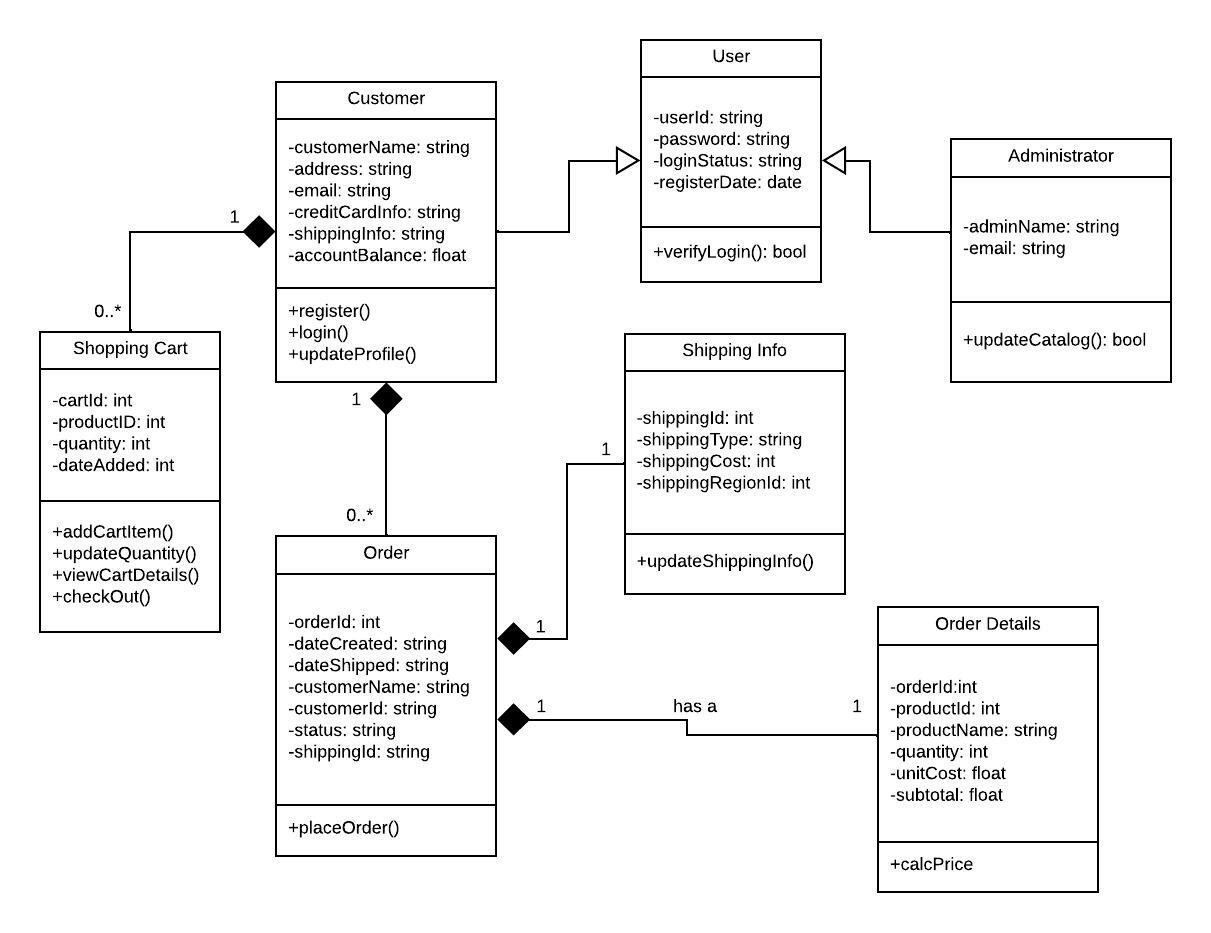
Show classes and relationships of the system
The User class has attributes for user ID, password, login status, and register date. There are the different return types on the right, and on the left, the visibility, which are set to private (with ”-” sign).
The values returned by these attributes would specifically describe an instance of the User class.
Down below we have a public method of verify login (verifyLogin()), returning a boolean.
Methods are behaviors of a class. So if a user is to log in to his/her user account, there’s a function in place that verifies the login credentials.
The arrow from Customer to User class tells us that Customer is a child of User. So Customer inherits all the attributes and methods of the User class. And same thing for the Administrator class.
Both of these classes inherit from User class, but also have their own specific attributes and methods. Like Administrator class can update catalog, but Customer class can’t.
Stemming from Customer, there are several lines with the closed-in diamond sign. So, these are composition relationships which means that the parts cannot exist without the whole. If an instance of the Customer class, if that customer’s account was destroyed, his Shopping Cart would be destroyed and his Orders would be lost. Shopping Cart and Order classes can’t exist outside of the Customer class.
The same applies for Shipping Info and Order Details. If there’s no Order, there’s not going to be any Order Details or Shipping Info.
Show multiplicity
A Customer can have zero or many orders. A customer account can be created for an online store but the customer will never buy anything. A frequent customer can place several different orders. And then on the flip side, an Order can belong to only one customer. It’d be pretty confusing if a specific Order with a unique order ID was duplicated across several different customers. That can be fixed with one-to-one relationship. Each Order has one and only one Order Details class. And Order Details belongs to one and only one Order.